
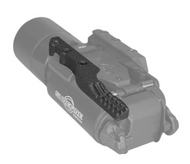
SureFire X300 Gas Pedal: What It Is, Who Needs It, and How to Actually Use It
May 17th 2026
The SureFire X300 is one of the most trusted weapon-mounted lights in the world. Military, law enforcement, and serious civilian shooters all run it for the same reasons: it is built to last, throws serious lumens, and holds up to recoil without fail.
But if you have spent any time shooting a pistol with an X300 mounted, you have probably noticed something. The switch housing on the side of the light sits there while your support thumb floats above the frame with nothing to press against. For shooters who care about getting their red dot back on target as fast as possible between shots, that floating thumb is wasted potential.
That is exactly the problem the SureFire X300 gas pedal thumb ledge solves.
What Is a Gas Pedal for a Pistol?
A gas pedal is an extended contact surface that attaches to the weapon-mounted light on your pistol. The name comes from the fact that your thumb presses it like a gas pedal in a car, firm, deliberate, consistent pressure.
Competition shooters have used thumb ledges on their pistols for years because the physics are simple: if your support thumb has something solid to press against at the front of the gun, you create a torque that fights muzzle rise. Your pistol comes back on target faster. Your splits get shorter. Your dot stays in the window.
The problem with traditional thumb ledges is that they widen the gun significantly and require a competition holster. The X300 gas pedal from Tactical Force USA takes a different approach: it uses the light body you already have as the anchor point, and the low-profile design keeps the overall width compatible with most holsters you already own.
How the SureFire X300 Gas Pedal Works
The gas pedal is a direct replacement for the factory side component of the X300. Once installed, it creates a textured platform on the support hand side of the light body that your thumb can press against with real force.
The technique is straightforward. Get your normal firing grip on the pistol. Place your support thumb on the gas pedal and apply forward and slightly downward pressure as you fire. You are pushing the muzzle down while the gun fires. The gas pedal gives you the contact surface to make that pressure effective.
The result is a flatter-shooting pistol with faster return to target. If you are running a red dot, your dot is back in the window sooner, which means faster split times in both competition and any scenario where a second shot is needed.
X300A vs X300B: Which Do You Have and Which Gas Pedal Do You Need?
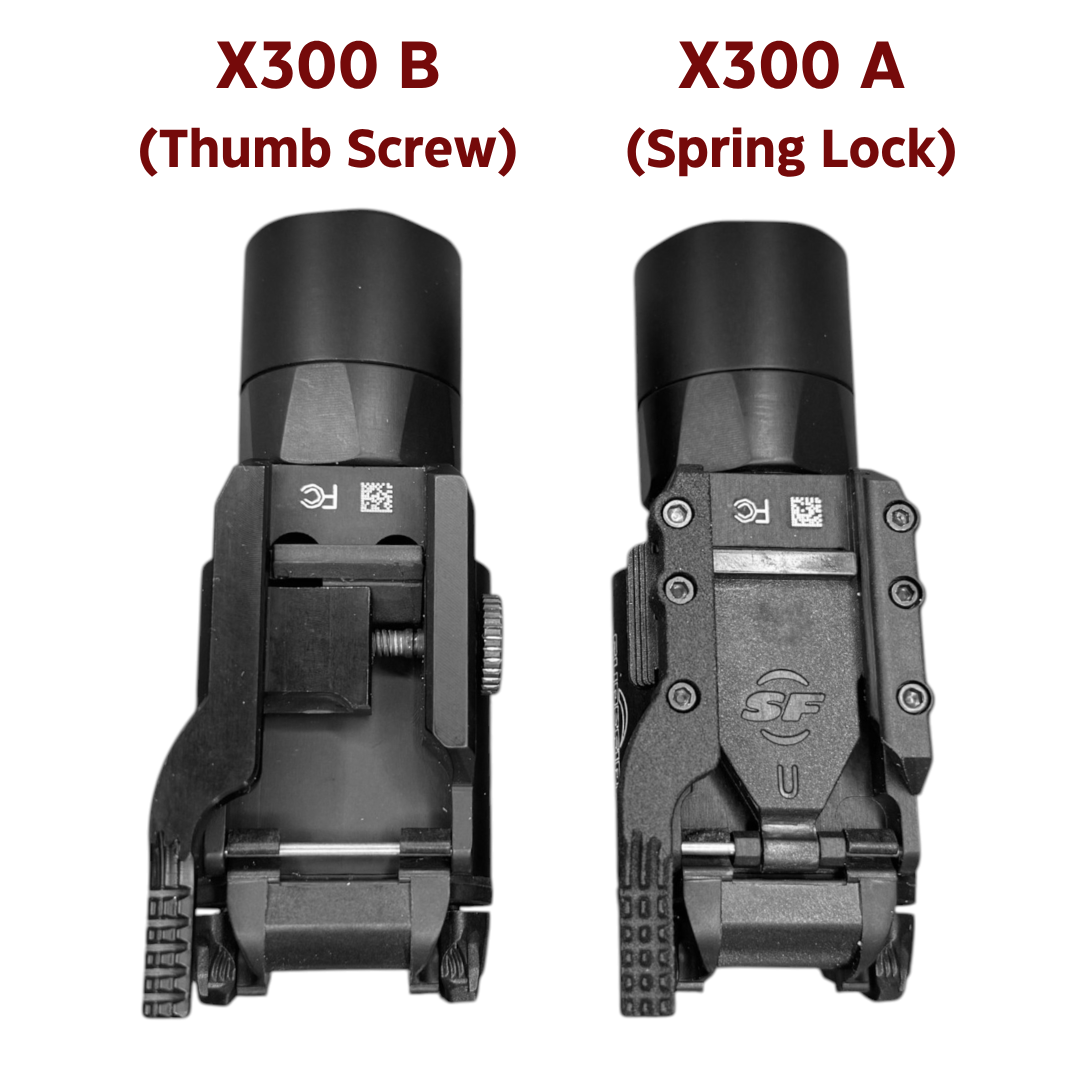
SureFire X300A — Spring Lock QD Model
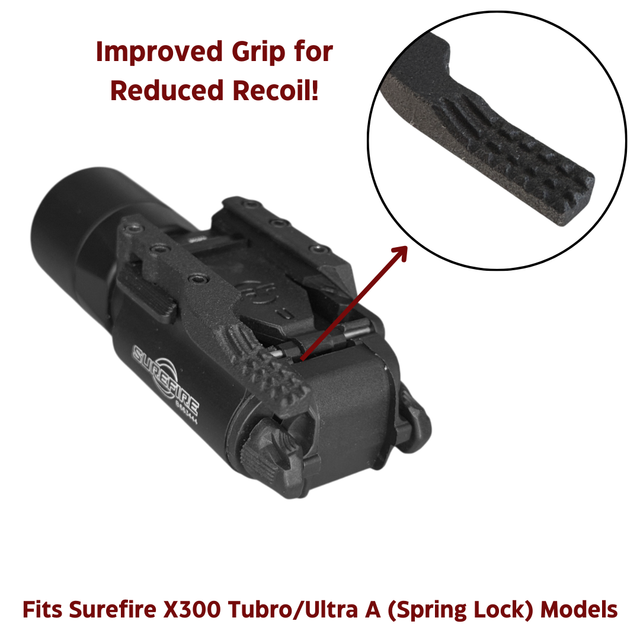
The X300A uses a spring-loaded quick-detach lever on the bottom rail mount. Installation uses the provided hex key to remove 3 socket head cap screws from the side of the light body, then the gas pedal mounts directly in their place. The X300A gas pedal from Tactical Force USA is made from MJF Nylon with a matte surface and naturally textured grip feel.
SureFire X300B — Thumb Screw Model
The X300B uses a thumb screw on the side of the light for rail attachment. Installation is simpler: unscrew the side bolt and replace it with the gas pedal unit. The X300B gas pedal is anodized aluminum that matches the factory SureFire finish and provides a rigid platform that does not flex under thumb pressure.
Select your variant when adding to cart. If you are unsure which X300 you have, look at the side of the light: a large flat head bolt on the side means X300B. A QD lever on the bottom mount means X300A.
Holster Compatibility: The Most Important Consideration
This is the question every pistol shooter has before adding any accessory to a weapon light. The Tactical Force USA X300 gas pedal is designed specifically to remain holster compatible with most common light-bearing holsters.
The design sits lower profile than traditional competition gas pedals. The X300 gas pedal adds minimal width to the light body and has been tested in duty and concealment holsters including Safariland ALS, level 2 and 3 duty holsters, and standard OWB designs.
If you run a tightly molded Kydex holster formed precisely to the X300 body, test fit before committing to a carry setup. Form-molded Kydex with zero clearance around the light body may need slight adjustment. Most OWB holsters with a large retention window accommodate the gas pedal without modification.
|
★ |
Running an IWB holster with a tight Kydex pocket? Test the draw with the gas pedal installed before relying on the setup for carry. Fit depends on how precisely the holster was molded to the X300 body. |
Who Actually Benefits From the X300 Gas Pedal?
Carry Optics Competition Shooters
Carry optics is one of the fastest-growing divisions in practical shooting. Faster splits are direct stage time reduction. The gas pedal is one of the few mechanical upgrades that translates immediately to measurable speed without requiring a new skill set.
Home Defense Pistol Owners
For a pistol in a home defense role with an X300 mounted, the gas pedal is most useful when you practice regularly with it. The benefit is that your natural grip already includes the thumb on the ledge, which means consistent recoil management without thinking about it in a high-stress situation.
Shooters With Smaller Hands or Compact Pistols
Compact pistols have less grip area and more felt recoil per shot. If you have a Glock 19, Sig P320 Compact, or similar platform with an X300, the gas pedal gives you a brace point the compact frame does not provide.
Installation Step by Step
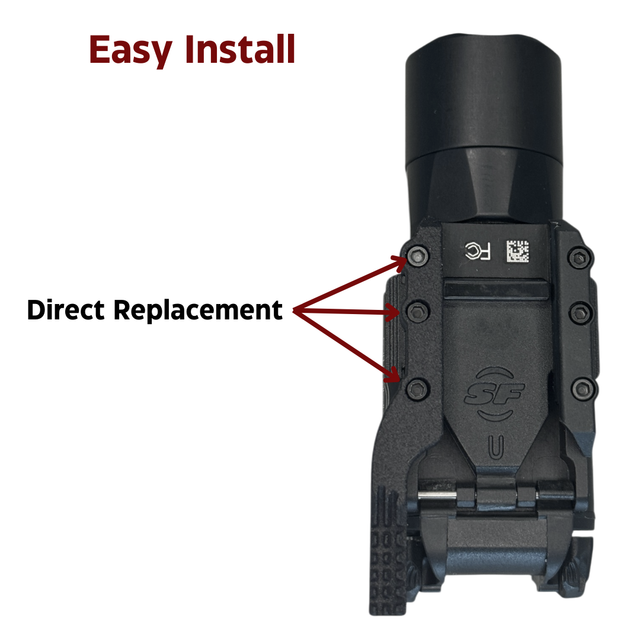
X300A Installation
Step 1: Field strip your pistol and remove the X300 from the rail. Step 2: Using the provided hex key, remove the 3 socket head cap screws from the side of the X300A body. Step 3: Position the gas pedal where the screws were. Step 4: Thread the provided screws through the gas pedal into the light body. Step 5: Tighten firmly. Step 6: Reinstall on the rail and test with your holster.
X300B Installation
Step 1: Locate the side bolt on the X300B. Step 2: Unscrew completely and set aside. Step 3: Position the gas pedal where the side bolt was. Step 4: Thread the gas pedal bolt into the light body in place of the factory bolt. Step 5: Tighten to seat the gas pedal solidly. Step 6: Test with your holster before carrying.
SureFire X300 Gas Pedal vs Competitors
White Wolf Concepts makes the most established aluminum gas pedal for the X300, priced significantly higher. Antimatter Industries makes a foldable deployable wing for X300B only. QVO Tactical makes the Thumb Cliff for X300A only.
The Tactical Force USA gas pedal fits both A and B variants at a lower price point, is made in the USA, and comes with a lifetime warranty. For shooters who want the function without the premium pricing, it is the direct answer.
Frequently Asked Questions
Does the gas pedal interfere with X300 battery access?
No. The battery compartment is accessed from the rear of the light. The gas pedal attaches to the side. Battery access is not affected on either model.
Can I use the gas pedal with a thumb-forward grip?
Yes. The gas pedal is specifically designed to complement the thumb-forward technique. Your support thumb lands naturally on the ledge, making the activation intuitive without changing your grip.
Bottom Line
The SureFire X300 is one of the best weapon lights available. The gas pedal thumb ledge from Tactical Force USA turns the light body you already own into a recoil control asset. Installation takes about 5 minutes, holster compatibility is preserved with most setups, and the technique improvement is immediate.
Get the SureFire X300 Gas Pedal Thumb Ledge from Tactical Force USA and find out what your X300 equipped pistol is actually capable of.
|
★ |
Also running a Streamlight TLR7? See the Streamlight TLR7 gas pedal thumb ledge — fits TLR7-X, SUB, and HL-X. And protect your weapon light lens with the weapon light lens cover for SureFire, Streamlight, Olight and Cloud Defense. |