
Anti-Reflective Devices: Everything You Need to Know About ARDs and Which One Your Optic Needs
Jul 12th 2026
An anti-reflective device, commonly called an ARD or KillFlash, is one of the most misunderstood accessories in the tactical shooting market. Shooters often dismiss it as a tactical gimmick until the first time they watch someone identify their position from a lens glint, lose a game animal to the same cause, or get a hot spot on their optic from direct sun. After that, ARDs become permanent equipment.
This guide covers what ARDs do, why the hex pattern matters, how to select the right one for your specific optic, and what to expect in terms of sight picture impact. Browse the complete Anti-Reflective Devices collection from Tactical Force USA to find your fit.
What Is an Anti-Reflective Device?
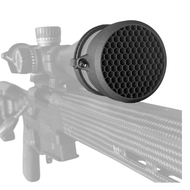
An ARD is a cover that fits over the objective lens of an optic, whether a red dot, a holographic sight, an LPVO, or a magnifier. The cover uses a hexagonal honeycomb mesh pattern to intercept incoming oblique light before it reaches the lens surface.
Without an ARD, sunlight or artificial light hitting the curved or flat lens surface at an angle creates a glint visible at distance. This glint is a tactical liability in any application where your position should not be obvious to game, opponents, or threats. The ARD breaks the smooth reflective surface into hundreds of tiny hex cells, each angled to diffuse rather than reflect the incoming light.
The Seven S's of Camouflage and Why "Shine" Is the Hardest to Control
Military camouflage doctrine identifies seven elements to control for effective concealment: shape, shadow, silhouette, surface, spacing, speed, and shine. Shine is consistently the most difficult to control because it is created by gear you need to use, not gear you can leave behind. Your optic is essential equipment, and it shines. An ARD is the direct countermeasure.
From World War II snipers taping their scopes, to modern special operations units running ARDs on every optical surface, the tactical community has recognized this problem for decades. The ARD is the engineered solution.
Hex Cell Size and Sight Picture Impact
The size of the individual hex cells in an ARD determines the balance between glare reduction and sight picture clarity. Smaller hex cells provide more complete glare suppression but create a more visible honeycomb pattern in the sight picture. Larger hex cells are less visible in use but reduce glare less effectively.
Tactical Force USA optimizes the hex cell size for each specific optic type. Red dot ARDs use smaller cells because the eye is close to the optic and parallax is minimal. LPVO and scope ARDs use larger cells to minimize the visible pattern at 1x magnification, where the eye relief and the full objective diameter are most sensitive to cell obstruction.
KillFlash for Each Optic Type
Trijicon RMR
The Trijicon RMR KillFlash is precision-fit for the RMR lens housing with snap-fit tabs that engage the body of the sight. The most widely used duty and competition red dot in its class.
EOTech EXPS and XPS
The EOTech KillFlash addresses the unique large flat aperture of holographic sights, which create more prominent reflection than tube optics. Covers EXPS2, EXPS3, XPS2, XPS3 and all three magnifier variants.
Holosun 507C and 407C
The Holosun KillFlash provides ARD coverage for one of the most popular budget-premium red dot series in the current market. One cover fits both 507C and 407C.
Aimpoint T1, T2, H1, H2, and CompM5
The Aimpoint KillFlash covers the full Aimpoint micro and CompM5 line. The Aimpoint lens coating creates a distinctive reddish-orange glint outdoors that this ARD removes.
LPVO and Scopes
The Scope KillFlash ARD covers Vortex, Leupold, Athlon, Burris, Trijicon, Primary Arms, and NightForce LPVOs. Available in multiple objective diameter sizes to match your specific scope front bell.
MJF Nylon vs Metal ARDs
Metal ARDs, particularly threaded aluminum options, are popular because of their perceived durability. However, smooth metal surfaces have a reflection problem of their own: the ARD housing itself can glint from indoor artificial lighting at certain angles. MJF Nylon has a naturally matte texture that absorbs rather than reflects ambient light. Tactical Force USA uses MJF Nylon for all ARD products for exactly this reason.
Complete ARD Coverage for Your Rifle Setup
The most effective approach is to cover every glass surface on your rifle. Red dot or scope with an ARD, magnifier with its own ARD if applicable, and weapon light lens cover for the flashlight. A rifle with all optical surfaces covered presents no glint signature at any relevant angle or distance.
|
★ |
Building a complete home defense setup? Pair your optic ARD coverage with the AR-15 Wall Mount, AR-15 Magazine Wall Mount, and Remington 870 shotgun wall mount for a complete tactical wall setup. |
Bottom Line
Anti-reflective devices are not optional equipment for any rifle used in conditions where your position matters. Whether that is a hunting stalk, a home defense setup, or a competition stage, the ARD eliminates the one variable that your expensive optic creates against you.
Shop the complete Anti-Reflective Devices collection from Tactical Force USA and find the right ARD for every optic in your setup.