
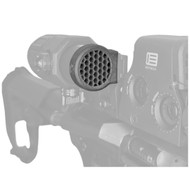
Aimpoint vs Trijicon RMR KillFlash: ARD Cover Comparison for Both Optics
Nov 8th 2026
The Aimpoint T1 / T2 and the Trijicon RMR are two of the most respected red dot sights in the tactical and defensive shooting community. Both are proven, durable, and widely used on rifles and pistols in serious applications. Both benefit from a KillFlash anti-reflection device, but the reasons and the mechanics differ between the two.
This guide compares how each optic uses ARD protection, what a KillFlash does for each platform, and which cover to get for each model.
The Aimpoint T1 and T2
The Aimpoint T1 and T2 are closed-emitter tube-style red dot sights commonly mounted on rifles, carbines, and subguns. The T2 is the updated version of the T1 with improved brightness and a slightly refined lens coating. Both use a 22mm objective lens and have an external profile defined by the circular tube body.
These sights are used by military and law enforcement units worldwide and are trusted for multi-year battery life, extreme durability, and consistent reticle clarity across brightness levels. They are typically used on rifle-length platforms — ARs, AKs, and similar — though some shooters mount them on handguns via a claw mount.
The Trijicon RMR
The Trijicon RMR is a pistol-optimized red dot sight with a distinctive housing that sits flush with the slide on most pistols when properly mounted. It is available in adjustable LED and dual-illuminated versions, with the Type 2 being the current standard. The RMR uses a very small objective lens compared to the Aimpoint and is designed to be as low-profile as possible on a carry or duty pistol.
The RMR is widely considered the benchmark for pistol red dot sights due to its proven track record with law enforcement and military users. Its small size means the KillFlash for the RMR is also small and very focused on lens protection rather than anti-glare at distance.
Why the Aimpoint Needs a KillFlash
The Aimpoint T1 and T2 are primarily rifle optics, and rifle optics used in field environments face the most significant lens glint challenge. A circular objective lens on a tube-body optic produces a particularly strong reflected glint signature because the full diameter of the lens can catch direct sunlight simultaneously.
In a hunting or field shooting context, this glint is visible at several hundred yards. On a defensive or tactical rifle, it reveals optic presence and approximate position. A KillFlash on the Aimpoint T1 / T2 breaks up this glint signature by filling the objective with a honeycomb pattern that diffuses reflected light.
The secondary benefit — physical lens protection — is also relevant for a rifle optic that gets used in field conditions, transported in a bag with other gear, or taken through brush.
Why the RMR Needs a KillFlash
The Trijicon RMR is almost exclusively used on pistols. At pistol carry distances and in everyday handling, the anti-reflection glint reduction matters less than on a rifle in an open field. However, the physical protection argument for a KillFlash on the RMR is strong.
A pistol optic gets reholstered hundreds or thousands of times over a carry gun's service life. The holster mouth, gear, and daily handling create conditions where the objective lens of the RMR takes more contact than a rifle optic ever would. Scratches on the objective lens of a pistol red dot reduce dot clarity in a way that is immediately noticeable during use.
A KillFlash on the RMR acts primarily as a lens protector that also provides the secondary benefit of anti-reflection protection when the pistol is at low-ready or when the objective lens is at an angle that could catch light.
? The RMR Type 2 has a very compact objective lens. Make sure any KillFlash you purchase is specifically designed for the RMR — generic covers will not fit correctly.
Comparing the Two Optics for ARD Value
Looking at both optics side by side:
Aimpoint T1 / T2 — Primary ARD value: Anti-reflection glint reduction
Rifle-mounted optic in field or tactical use. A KillFlash significantly reduces the optic signature from angles that would catch direct sunlight. Physical protection is a secondary but real benefit for a field rifle.
Trijicon RMR — Primary ARD value: Physical lens protection
Pistol-mounted optic with a small objective lens. A KillFlash protects the lens from the daily wear of reholstering and handling. Anti-reflection protection is secondary but relevant when drawing from concealment or retention.
Which KillFlash to Get
The Aimpoint and RMR use different mounting interfaces and lens diameters, so the KillFlash for each is specific to the model. Verify you are ordering the correct ARD for your optic.
Aimpoint T1 / T2 KillFlash ARD Cover
Trijicon RMR KillFlash ARD Cover
Also available for EOTech and Holosun:
Holosun 507C / 407C KillFlash ARD
Final Thoughts
Both the Aimpoint and the RMR benefit from a KillFlash, but the value proposition is different. For the Aimpoint on a rifle, the anti-reflection signature reduction is the main reason to run an ARD. For the RMR on a carry pistol, physical lens protection from daily use is the primary driver.
Either way, a KillFlash is a straightforward way to protect an optic that cost several hundred dollars and to reduce your signature in field or defensive use.